
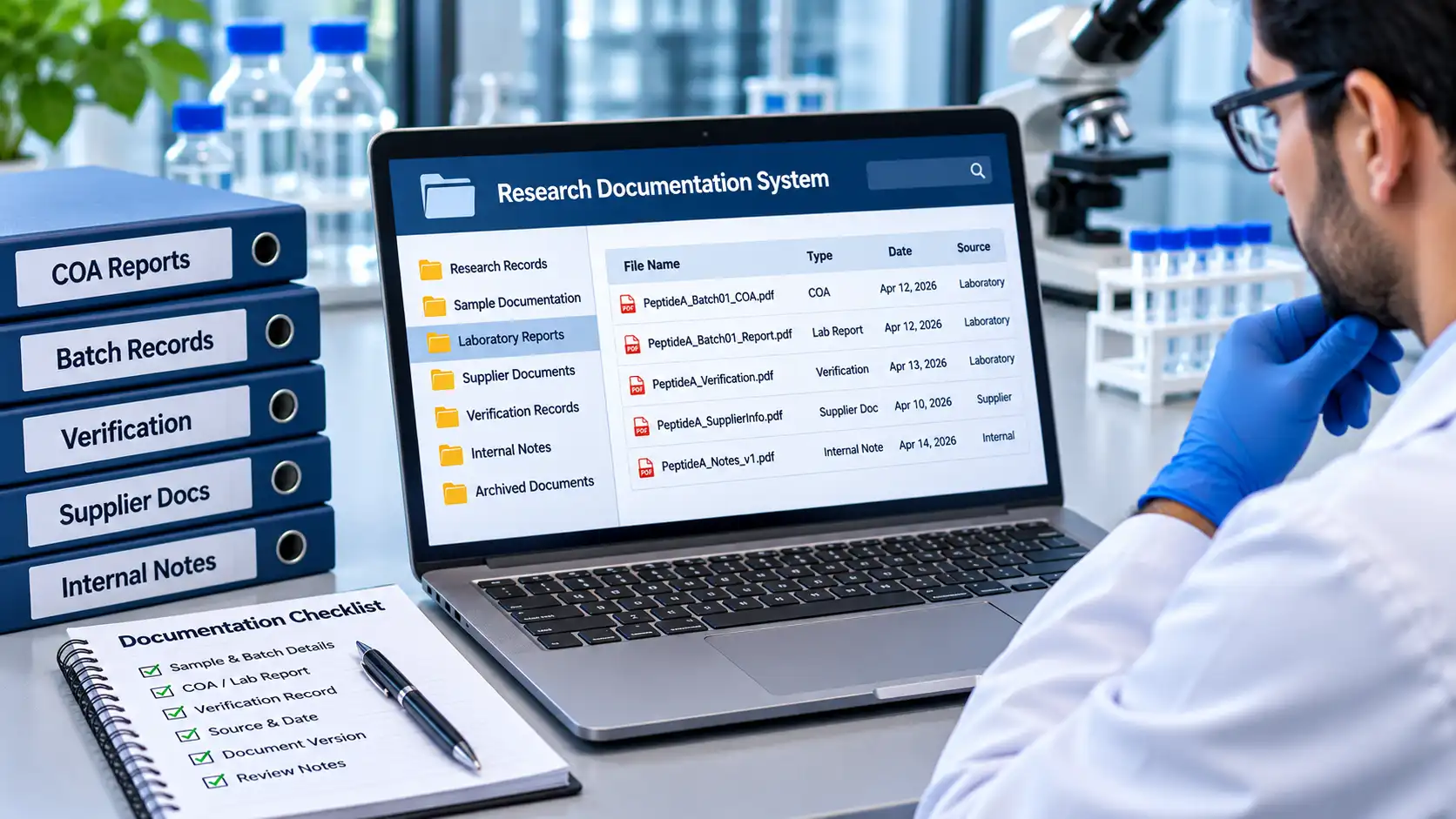

Maintaining research documentation involves more than saving laboratory reports and certificates in a folder. Research organisations need a consistent system for identifying documents, recording their sources, maintaining historical versions and retrieving the correct information when required.
For research organisations in the UAE, an organised documentation system can make it easier to manage records across different samples, batches and testing events. It can also help distinguish original laboratory reports from supplier-provided information and internal administrative notes.
Research peptide documentation should therefore be managed as a structured record-management process. Each document should have a clear purpose, identifiable source and connection to the relevant research record.
Why an Organised Documentation System Matters
Research records may accumulate over time as new samples are documented, laboratory reports become available and existing records are updated.
Without a consistent filing approach, important documents can become difficult to locate. Similar filenames, incomplete references and multiple versions of the same document may also create confusion.
For example, a research team may receive several laboratory reports relating to different samples. If these documents are stored without clear identifiers, an authorised reviewer may struggle to determine which report belongs to a particular record.
A structured documentation system helps address these issues by providing consistent naming conventions, organised storage locations and clear document references.
The objective is not simply to store more information. It is to make existing information easier to retrieve, understand and review.
Create a Consistent Folder Structure
The first step is to establish a central location for research documentation. This may be a secure digital document-management platform or an organised folder system with appropriate access controls.
A practical folder structure can separate records into logical sections:
- Research records: General documentation relating to research activities.
- Sample documentation: Identification details and descriptions of individual samples.
- Laboratory reports: Original reports issued by analytical laboratories.
- Supplier documents: Information received from suppliers or other external organisations.
- Verification records: Available online verification details and related correspondence.
- Internal notes: Administrative explanations, review notes and document-management records.
- Archived documents: Previous versions and historical records retained for reference.
The exact structure can vary depending on the organisation’s requirements. The important point is to apply the same filing approach consistently.
Access permissions should also be considered. Only authorised personnel should be able to modify or replace controlled records, while relevant reviewers should be able to retrieve the documents they need.
Use Clear and Consistent File Names
Unclear filenames can make document retrieval unnecessarily difficult.
Names such as report-final.pdf, document-new.pdf or COA-updated.pdf do not provide enough information to identify a record without opening it.
A consistent naming convention can include:
- Sample or product reference
- Batch or lot identifier, where available
- Document type
- Laboratory reference, where relevant
- Document or report date
For example, an internal filename might follow this structure:
SampleReference_BatchReference_LabReport_YYYY-MM-DD.pdf
This is an illustrative naming format, not a laboratory-issued report identifier. Organisations should use their own documented references and avoid creating identifiers that could be mistaken for official laboratory numbers.
If a batch reference is unavailable, it should be recorded as unavailable rather than invented.
Maintain Document Versions and Historical Records
Document management should account for updates and older records.
When a new laboratory report or supporting document is received, it should be saved as a separate record with its own identifying details. An earlier document should not automatically be deleted or overwritten.
A version history can help authorised reviewers understand:
- When a document was received.
- Whether it replaced or supplemented an earlier record.
- Who added or updated the internal record.
- What changes were made to the filing information.
- Where the original document is stored.
This is particularly important when two reports relate to different samples or testing events. Similar names do not mean that the documents are interchangeable.
Retaining relevant historical records also makes it easier to understand how documentation has developed over time.
Keep Original Laboratory Reports Separate From Supporting Documents
A well-organised system should clearly distinguish between original laboratory-issued reports and information added by other organisations.
Research documentation may include several different source types:
Original laboratory reports: Documents issued by the laboratory that performed the analysis.
Supplier-provided information: Product descriptions, sample references or other details supplied by an external provider.
Internal administrative records: Notes created by the research organisation for filing, tracking or review purposes.
Online verification records: Information retrieved from a laboratory’s verification system, where available.
Additional correspondence: Emails or explanations that provide context about a document or its source.
These records should not be presented as though they all have the same evidential status. For example, a supplier description should remain distinguishable from a finding recorded in an original laboratory report.
Where online verification is available, the relevant reference and verification details can be retained alongside the original document. The verification record should not replace the original report.
Record the Scope and Limitations of Laboratory Findings
A useful documentation system should preserve enough information to explain what a laboratory report actually covers.
Alongside the original report, an internal record may identify the laboratory, analytical method, report date, sample description and any stated limitations.
For example, High-Performance Liquid Chromatography (HPLC) may be used to assess chromatographic purity. When recording such a result, the organisation should retain the analytical method and the context provided in the original report.
A chromatographic purity result does not independently establish sterility, molecular identity or suitability for human or veterinary use.
It is also important to maintain sample-specific context. A laboratory report applies to the particular sample identified in that report. It does not automatically confirm other batches, strengths or formats.
Some product associations may be mapped by suppliers across different strengths or formats. These associations should be recorded as supplier-provided information, not as independent laboratory confirmation of every associated product.
Similarly, a published report should not be treated as confirmation of a current shipping lot unless the available documentation specifically establishes that connection.
Keeping these distinctions in the record system helps prevent information from being interpreted more broadly than the available evidence supports.
Build a Simple Documentation Index
A central index or spreadsheet can make a large collection of research records easier to manage.
Rather than opening individual folders to locate a document, authorised reviewers can use an index to find the relevant record and its storage location.
A practical index may include:
| Record field | Information to maintain |
| Sample reference | Internal sample identification |
| Batch or lot reference | Identifier, where available |
| Document type | COA, laboratory report, supplier document or internal note |
| Laboratory | Name of the issuing laboratory, where applicable |
| Report reference | Original laboratory reference, where available |
| Document date | Date shown on the document |
| Source | Laboratory, supplier or internal record |
| Verification status | Whether an available verification record has been checked |
| Storage location | Folder path or document-management reference |
| Review notes | Relevant limitations or administrative comments |
The index should distinguish between confirmed information and details that have not been supplied or independently established.
For example, a verification status should indicate whether a report was checked against an available laboratory record. It should not imply that every characteristic of the associated material has been independently confirmed.
Common Documentation Mistakes to Avoid
Even when original documents are available, poor record management can reduce their usefulness.
Several common mistakes are worth avoiding:
- Mixing document sources: Do not present supplier information or internal notes as original laboratory findings.
- Using unclear filenames: Avoid generic names that make documents difficult to identify.
- Overwriting previous records: Retain relevant historical versions instead of silently replacing earlier reports.
- Saving only screenshots: Screenshots may omit important references or report details. Retain the original document whenever possible.
- Assuming sample associations: A report for one tested sample should not automatically be associated with another batch, strength or format.
- Ignoring testing limitations: Keep the analytical method and relevant limitations with the documented result.
- Leaving verification status unclear: Record what was checked and what remains unconfirmed.
These practices help maintain a more consistent and traceable documentation process.
Reviewing Published Research Documentation
Published laboratory documentation can provide additional information for readers reviewing research-related records.
Remy Research provides research-focused information and access to published laboratory documentation through its peptide lab reports section.
When reviewing a published report, readers should refer to the original laboratory document wherever available. The sample description, report reference, analytical method and stated limitations should remain connected to the specific record.
Published information should not be interpreted as confirmation of unrelated samples, different product formats or current shipping lots unless the original documentation establishes those connections.
A research information platform can help make records accessible, but the scope of the underlying laboratory findings remains unchanged.
Final Thoughts
Organising research peptide documentation requires a consistent approach to file storage, naming conventions, document versions and source identification.
For UAE research organisations, a central documentation system and a simple record index can make laboratory reports easier to retrieve and review. Separating original laboratory documents from supplier information and internal notes also helps preserve the source and context of each record.
Most importantly, documentation should accurately reflect what is known, what was tested and what remains unconfirmed. A well-maintained record system supports clarity and traceability without making claims beyond the available evidence.
Research-use-only notice: The materials discussed in this article are intended exclusively for in-vitro laboratory research and documentation purposes. They are not intended for human or veterinary use. This article does not provide medical advice, treatment recommendations or administration instructions.